
Why professional cleaning between tenants protects your property
Why professional cleaning between tenants protects your property
There is no general legal requirement for UK landlords to hire professional cleaners between tenancies. That said, the Homes (Fitness for Human Habitation) Act 2018 does require every property to be clean and fit for habitation at the start of a new tenancy. For houses in multiple occupation, the obligation goes further: HMO managers must ensure each unit and its furnishings are clean at the beginning of every new occupation under The Management of Houses in Multiple Occupation (England) Regulations 2006. For everyone else, professional cleaning is not compulsory, but the practical case for it is hard to argue with.
Key points at a glance:
- No blanket legal duty to use professional cleaners, except in HMOs.
- The Homes (Fitness for Human Habitation) Act 2018 sets a cleanliness and habitability standard landlords must meet.
- The Tenant Fees Act 2019 prohibits fixed cleaning charges; landlords may only deduct reasonable cleaning costs from a deposit where the property is left below the agreed standard.
- Tenants must return the property in the same condition as they received it, accounting for fair wear and tear.
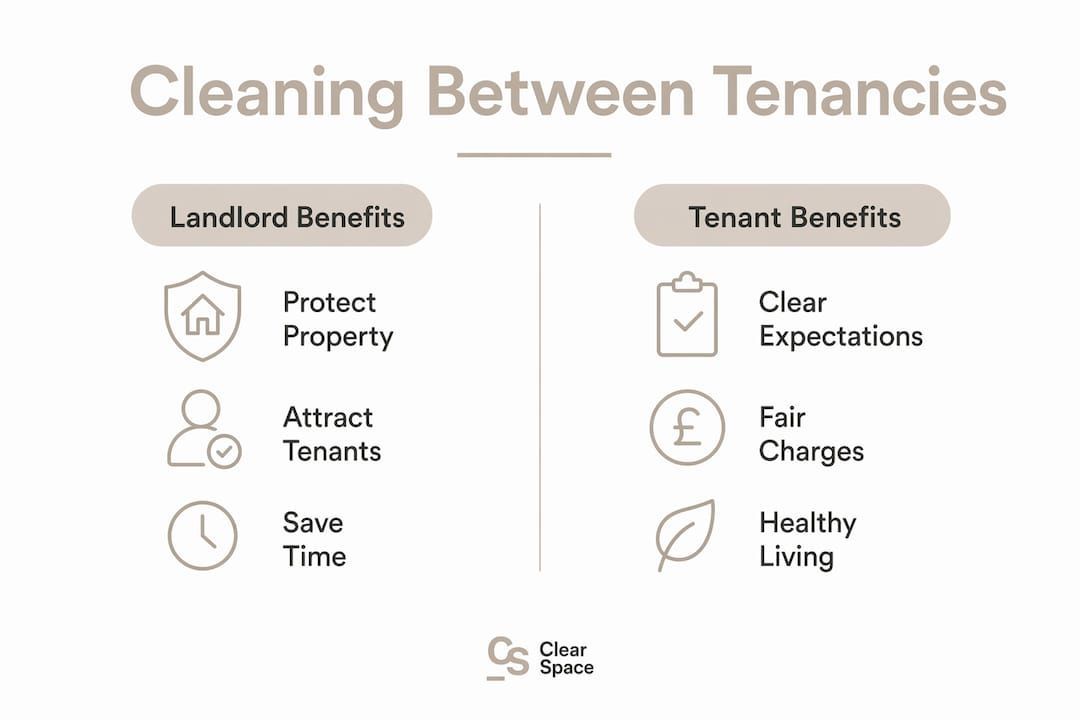
- Professional cleaning reduces deposit disputes, shortens void periods, and protects long-term property value.
Who is responsible for cleaning at the end of a tenancy?
Both landlords and tenants carry distinct obligations, and confusing them is where most disputes begin. A landlord must provide a property that is clean and fit to live in from day one. A tenant must return it in broadly the same condition, minus reasonable wear and tear.
Landlord responsibilities:
- Present the property clean and in good repair before a new tenancy starts.
- Carry out any cleaning or maintenance that falls outside the outgoing tenant's obligations.
- Ensure gas appliances, fixtures, and fittings are in clean working order, as required under HSE guidance for landlords.
- Document the property's condition thoroughly before handing over keys.
Tenant responsibilities:
- Leave the property at the same cleanliness standard as recorded at check-in.
- Clean all rooms, appliances, and fixtures to the level shown in the inventory.
- Remove all possessions and dispose of rubbish before vacating.
- Be present at the check-out inspection where possible, and take dated photographs.
The inventory and check-in condition report are the documents that settle almost every cleaning dispute. Without them, neither party has a reliable reference point. Contested areas typically include oven interiors, extractor fans, bathroom grout, and carpets — places that look passable at a glance but fail closer inspection.
Pro Tip: Photograph every room on the day keys are handed over, with timestamps. A dated photo of a clean oven at check-in is worth more than any clause in a tenancy agreement when a dispute reaches a deposit scheme adjudicator.

What UK law actually says about tenancy cleaning
The legal framework is more nuanced than most landlords and tenants realise, and getting it wrong can be costly.
Key legislation:
- Homes (Fitness for Human Habitation) Act 2018: Landlords must ensure properties are safe, clean, and fit for habitation at the start of a tenancy. A property handed over in a dirty or unhygienic state could breach this duty.
- Tenant Fees Act 2019: Landlords cannot charge a fixed professional cleaning fee as a condition of the tenancy. Any deduction from a deposit must reflect the actual, reasonable cost of restoring the property to its check-in standard.
- The Management of Houses in Multiple Occupation (England) Regulations 2006: HMO managers face a specific legal duty to ensure units are clean at the start of each new occupation.
- How to Let (GOV.UK guidance): The government recommends landlords have the property cleaned to a professional standard and prepare a detailed inventory before each new tenancy.
Cleaning is the biggest cause of deposit disputes and deductions, making it the main source of friction between landlords and tenants at the end of a tenancy.
The Tenant Fees Act 2019 is frequently misunderstood. It does not prevent landlords from recovering cleaning costs. It prevents them from imposing a blanket professional cleaning fee regardless of the property's condition at check-out. If a tenant leaves the property genuinely dirty, a reasonable deduction is lawful. The standard is always the check-in condition, not an arbitrary "professionally cleaned" benchmark.
Is professional cleaning required, and who pays?
Professional cleaning is rarely a legal requirement for standard assured shorthold tenancies. The obligation is to meet the check-in standard, not to exceed it. If the property was handed over with a basic clean, a basic clean on departure is sufficient.
What the rules actually allow:
- Tenants cannot be forced to pay for professional cleaning unless the tenancy agreement specifies it and the property was professionally cleaned at the start.
- Landlords may deduct reasonable cleaning costs from the deposit if the property is left below the agreed standard.
- Deductions must be proportionate and evidenced; a deposit scheme adjudicator will not accept vague claims.
- Forcing a tenant to pay for professional cleaning when the original condition did not warrant it is unlawful under the Tenant Fees Act 2019.
Consequences of failing to clean adequately:
- Deposit deductions for the cost of a professional clean, which often exceeds what a tenant would have paid voluntarily.
- Delayed re-letting while the landlord arranges remedial cleaning, extending void periods.
- Failed DIY cleaning can cost more overall than a professional service once re-clean fees and lost rental income during the void are factored in.
The most common misconception is that tenants must pay for professional cleaning by default. They do not. The legal standard is always to match the check-in condition, and a well-documented inventory is what determines whether that standard has been met.

Best practices for landlords between tenancies
Getting the property ready for a new tenant is not just about cleaning. It is about protecting your asset, reducing the time it sits empty, and starting the new relationship on solid ground.
Practical steps every landlord should take:
- Schedule a professional deep clean between every tenancy, particularly for kitchens and bathrooms where grime accumulates in hard-to-reach spots.
- Carry out a thorough check-out inspection with the outgoing tenant present, using the original inventory as your reference.
- Document the property's condition with dated photographs immediately after the outgoing tenant leaves and again after cleaning.
- Use the cleaning process as an opportunity to identify hidden maintenance issues. Dirt often conceals mould, leaks, or damage that only become visible once surfaces are properly cleaned.
- Communicate cleaning expectations clearly to incoming tenants at the start of the tenancy, and provide them with a copy of the inventory.
- Time the clean to fit your re-letting schedule. A professional team working to a fixed brief will turn the property around faster than a DIY effort that needs revisiting.
- Keep a record of all cleaning invoices and photographic evidence. These are your primary defence if a deposit dispute reaches a tenancy deposit scheme.
A clean property also photographs better for listings, attracts more enquiries, and tends to attract tenants who treat the property with greater care. That is not a guarantee, but it is a pattern landlords notice.
How Clearspaceherts supports landlords and tenants in Hertfordshire
Clearspaceherts (ClearSpace Home Solutions Ltd) is a local, family-run business covering St Albans, Harpenden, Hemel Hempstead, Welwyn Garden City, Hatfield, Berkhamsted, and the surrounding areas. The team works with landlords, letting agents, and tenants to prepare properties between tenancies, combining cleaning, decluttering, clearance, and home organisation into one straightforward service where needed.
What Clearspaceherts offers:
- End of tenancy cleaning covering kitchens, bathrooms, carpets, appliances, and hard-to-reach areas that DIY efforts routinely miss.
- Property clearance and decluttering for landlords dealing with items left behind by outgoing tenants.
- Photographic documentation of the property's condition before and after cleaning, supporting deposit-dispute-ready evidence.
- Flexible scheduling to fit tenancy handover timelines and minimise void periods.
- Combined services for landlords who need cleaning, clearance, and minor organisation handled in a single visit.
Clearspaceherts focuses on clear communication and reliable delivery. Every job is tailored to the property and the situation, whether that is a straightforward end-of-tenancy clean in St Albans or a full clearance and deep clean for a landlord resetting a longer-term tenancy. For landlords managing multiple properties or working to tight re-letting timelines, the landlord property services page sets out how Clearspaceherts can help.
Pro Tip: Book the clean as soon as the outgoing tenant gives notice, not after they leave. It keeps your timeline tight and means you are not scrambling for availability during busy periods like late summer, when tenancy turnovers peak.
Key takeaways
Professional cleaning between tenancies is not legally required for most UK landlords, but it is the most reliable way to protect your deposit, your property, and your re-letting timeline.
| Point | Details |
|---|---|
| Legal standard is check-in condition | Tenants must return the property to its original cleanliness level, not necessarily professionally cleaned. |
| HMOs face a specific legal duty | The Management of Houses in Multiple Occupation (England) Regulations 2006 require units to be clean at each new occupation. |
| Cleaning drives most deposit disputes | Cleaning is the biggest cause of deposit disputes and deductions, making it the main friction point at tenancy end. |
| Landlords cannot charge fixed cleaning fees | The Tenant Fees Act 2019 prohibits blanket cleaning charges; deductions must reflect actual, reasonable costs. |
| Professional cleaning shortens void periods | Failed DIY cleaning delays re-letting and can cost more than a professional service once lost rental income is included. |