
Why professional packing matters for your move
Why professional packing matters for your move

Professional packing is the expert method of preparing household belongings for transport, using trained techniques and quality materials to prevent damage, save time, and protect your legal rights during a move. Whether you are relocating across Hertfordshire or downsizing to a smaller property, the difference between a careful professional pack and a rushed DIY effort can mean the difference between your belongings arriving intact or arriving broken. Most people underestimate this until something goes wrong. Understanding why professional packing matters before your move puts you firmly in control of the outcome.
Why professional packing matters more than most people realise
Professional packing, sometimes called relocation packing or removal packing in the industry, is far more than placing items into boxes. It is a structured process that accounts for weight distribution, fragility, transit vibration, and legal documentation. Most losses in moves originate from improper packing rather than transport alone. That single fact reframes the entire conversation: the lorry driver is rarely the problem. The box that was not packed correctly is.
The benefits of expert packing fall into three clear categories: time, protection, and compliance. Professional teams work methodically and quickly, often completing in a day what would take a household several weekends. They use double-walled boxes, acid-free tissue, foam wrap, and custom crating for high-value pieces. They also create written inventories and label every box by room and content, which makes unpacking at the other end far less chaotic.

For anyone downsizing, the advantages multiply. Downsizing requires decisions about what to keep, store, or clear, and a professional packer can work alongside a decluttering service to handle both in a single visit. Clearspaceherts offers exactly this kind of combined support across St Albans, Harpenden, Hemel Hempstead, and surrounding areas, which means fewer separate appointments and less disruption to your daily routine.
What are the main benefits of professional packing compared to DIY?
The gap between professional and DIY packing is wider than most people expect, and it shows up in three practical areas.
Time and physical effort
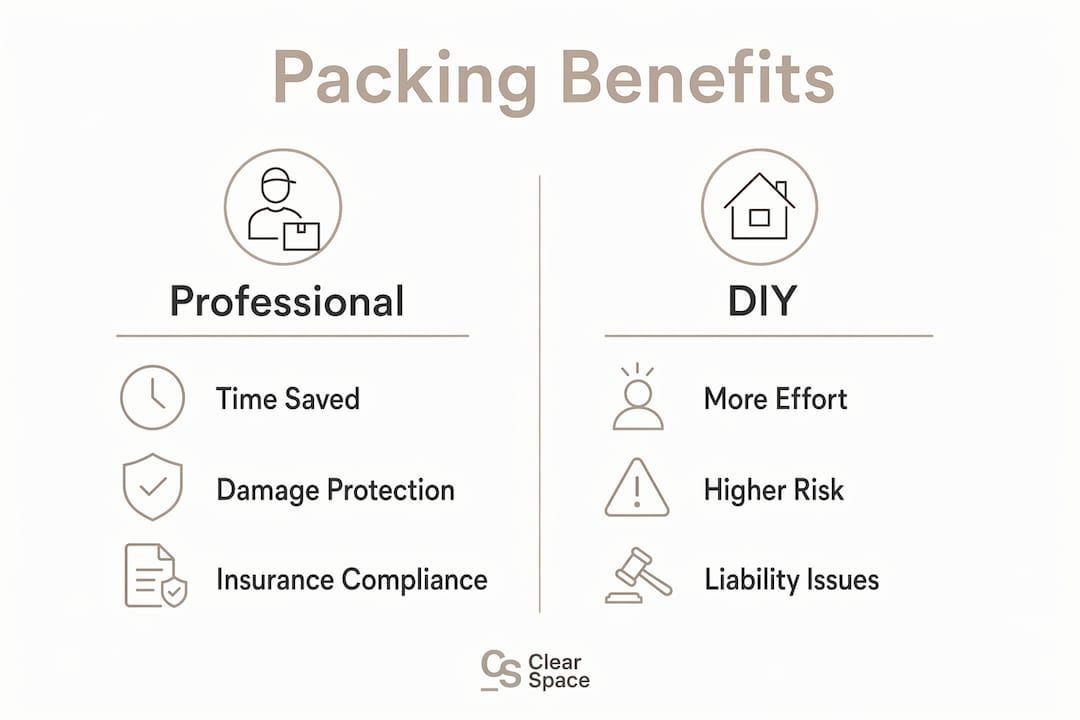
Professional packing clients typically save days of work and avoid the physical strain of lifting and wrapping heavy, awkward items themselves. For a three-bedroom house, a trained two-person team can complete a full pack in six to eight hours. The same job done by the homeowner, working evenings and weekends around a job and family, often stretches across two to three weeks. That extended timeline increases stress and leaves more room for last-minute errors.
Protection of fragile and high-value items
Professionals use layering, cushioning, and bracing techniques that most DIY packers simply do not know. Glassware is individually wrapped in foam pouches and packed upright, not on its side. Artwork travels in mirror boxes with corner protectors. Electronics go into anti-static wrap before being placed in double-walled cartons. These are not minor refinements. They are the difference between a claim and a clean delivery.
- Double-walled boxes for heavy kitchenware and books
- Foam wrap and bubble wrap for ceramics and glassware
- Anti-static bags for electronics and hard drives
- Custom timber crating for antiques and large mirrors
- Wardrobe boxes that keep hanging clothes crease-free
Pro Tip: Ask your packing service to show you the materials they use before the job begins. Quality packing materials, such as those available from Clearspaceherts, are a reliable indicator of the standard of care you can expect on moving day.
Stress reduction
Moving consistently ranks among the most stressful life events. Handing the packing to professionals removes one of the largest and most time-consuming tasks from your list. It also reduces the risk of arguments, injuries from lifting, and the particular misery of discovering a broken item after the van has left.
How does professional packing affect your liability and insurance during a move?
This is the section most moving guides skip entirely, and it is the one that can cost you the most money if you ignore it.
When you move goods via a removal company or freight carrier, your legal position depends heavily on how those goods were packed. Inadequate packaging gives carriers a legal defence not to pay damage claims. Under liability frameworks derived from the Carmack Amendment, a carrier can argue that damage was caused by the shipper's own failure to pack adequately, effectively transferring the financial loss back to you. This is not a technicality buried in small print. It is a well-established legal principle that removal companies and freight carriers use regularly.
"Courts assess packaging adequacy as a transport survivability test, meaning excellence is not required, only packaging that can survive routine transit conditions without damage."
The standard is not perfection. Packing must withstand normal transport hazards including vibration, stacking pressure, and temperature changes. A professional packer understands this standard and packs to meet it. A DIY packer usually does not know the standard exists.
| Packing scenario | Likely outcome for damage claims |
|---|---|
| Professionally packed with written inventory | Strong claim position; carrier bears burden of proof |
| DIY packed, no inventory | Carrier can invoke 'act of shipper' defence |
| High-value items listed on pre-move inventory | Full value protection applies |
| High-value items not declared before loading | Coverage may revert to limited released value |
| Damage noted on bill of lading at delivery | Claim preserved; written notice within 5 days required |
Damage notations on the bill of lading are the primary evidence in freight damage claims, and concealed damages require prompt written notice within five days. A professional packer will document the condition of your belongings before loading, creating a paper trail that protects you if anything goes wrong.
Items exceeding £100 per pound in value require a special high-value inventory listing to be fully covered under most full value protection plans. Failing to list them before loading risks reverting to limited released value coverage, which pays out a fraction of the actual replacement cost. A professional packing service will flag these items and complete the necessary paperwork before the van is loaded.
What packing strategies do professionals use to protect your belongings?
The techniques professionals use are systematic, not instinctive. They follow a repeatable process that reduces the chance of human error on a busy moving day.
- Room-by-room assessment. Before a single box is packed, professionals walk through the property and categorise items by fragility, weight, and value. This determines which materials are needed and how boxes will be loaded onto the vehicle.
- Layering and cushioning. Every box is lined with packing paper at the base. Fragile items are individually wrapped and surrounded by void fill. Nothing moves inside the box when it is shaken. This is the transport survivability test in practice.
- Weight distribution. Heavy items go at the bottom of boxes, lighter items on top. Boxes are filled to capacity so they do not collapse under stacking pressure in the van.
- Specialised materials for specific items. Electronics receive anti-static protection. Mirrors and artwork travel in purpose-built flat boxes. Clothing stays on hangers inside wardrobe boxes, arriving ready to hang in the new property.
- Systematic labelling and inventory. Professional packers use labelling systems that include the destination room, a brief content description, and a handling instruction such as "fragile" or "this way up." A master inventory ties every box number to its contents, which makes unpacking faster and makes any missing item immediately traceable.
Pro Tip: If budget is a concern, consider a partial packing service. Hybrid packing approaches let you pack everyday items yourself while professionals handle fragile, high-value, and awkward pieces. You get the protection where it counts most without paying for the whole job.
Partial packing is particularly popular for moves involving antiques, home offices with multiple screens, or kitchens with extensive glassware. It balances cost and security without compromising the items most likely to be damaged.
What are the most common DIY packing mistakes?
DIY packing fails in predictable ways. Knowing the patterns helps you understand exactly what professional packers are trained to avoid.
| DIY mistake | Professional approach |
|---|---|
| Using old, weakened boxes from supermarkets | New double-walled boxes rated for the load |
| Insufficient cushioning around fragile items | Individual wrapping plus void fill throughout |
| Overfilling boxes until they split | Boxes filled to rated capacity, never beyond |
| Mixing heavy and light items in one box | Weight-graded packing by item category |
| No labelling or vague labels | Room, contents, and handling instructions on every box |
| No written inventory | Full itemised inventory completed before loading |
Poor packing shifts responsibility to the shipper under carrier liability exceptions, meaning the financial consequences of these mistakes extend well beyond a broken mug. A cracked television screen or a shattered antique vase can represent hundreds or thousands of pounds in unrecoverable loss if the packing was inadequate and the carrier can demonstrate it.
The disorganisation problem is equally costly in time. Boxes with no labels or generic labels like "kitchen stuff" turn unpacking into a multi-day scavenger hunt. Professional packers treat the inventory as part of the job, not an optional extra.
Key takeaways
Professional packing reduces damage risk, protects your legal position with carriers, and saves significant time compared to DIY methods.
| Point | Details |
|---|---|
| Damage prevention | Most move losses stem from poor packing, not transit; professionals eliminate this with trained techniques. |
| Legal protection | Adequate packing preserves your right to claim against carriers; poor packing hands them a legal defence. |
| High-value items | Items over £100 per pound must be listed on a pre-move inventory to maintain full insurance coverage. |
| Time savings | Professional teams complete in hours what DIY packing stretches across days or weeks. |
| Partial packing | A hybrid approach protects fragile and valuable items professionally while keeping costs manageable. |
What I have learnt from watching people pack for a move
Most people book the removal van first and think about packing second. In my experience, that order is backwards. The packing plan should come first, because it determines how long the job takes, what materials you need, and whether your insurance actually covers you if something breaks.
The clients who have the smoothest moves are almost always the ones who either hired professionals to pack everything or sat down with a packing service early to identify which items genuinely needed expert handling. They did not try to save money on bubble wrap for a £2,000 television. They did not use bin bags for fragile items because they ran out of boxes the night before.
I also think the legal side of packing is genuinely underappreciated. People assume that if the removal company breaks something, the removal company pays. That is not always true. If you packed the box and the box was inadequate, you may be carrying the loss yourself. That is a conversation worth having before moving day, not after.
The hybrid approach, where a professional handles fragile and high-value items while you manage books, linen, and everyday items, is often the most sensible solution for people on a tighter budget. It concentrates professional expertise exactly where it matters most. If you are planning a move in Hertfordshire and want to talk through what that might look like for your property, Clearspaceherts is worth a conversation early in the process.
— Ashlea
Ready to take the stress out of your move?
Clearspaceherts provides packing and moving support across Hertfordshire, covering St Albans, Harpenden, Hemel Hempstead, Welwyn Garden City, Hatfield, and surrounding areas. Whether you need a full professional pack, help with fragile and high-value items, or a combined packing and decluttering service before you move, the team can put together a practical plan around your timeline and budget.
As a local, family-run business, Clearspaceherts combines packing support with home clearance, organisation, and cleaning services, so you can manage your entire move through one straightforward conversation rather than coordinating multiple separate companies. Get in touch to discuss your move and find out how the team can help.
FAQ
What does professional packing actually include?
Professional packing covers the supply of quality materials, individual wrapping of fragile items, weight-graded box packing, systematic labelling, and a written inventory of all packed items. Some services also include partial packing options for clients who want to manage everyday items themselves.
Does professional packing affect my insurance claim if something breaks?
Yes, significantly. Carriers can refuse claims where packaging was inadequate, shifting the loss to the shipper. Professionally packed goods with a written inventory give you a much stronger legal position if damage occurs during transit.
Is professional packing worth the cost for a small move?
For small moves, partial packing is often the most cost-effective route. Professionals handle fragile and high-value items while you pack everyday belongings, giving you protection where it matters most without paying for a full-service pack.
How far in advance should I book a packing service?
Book at least two to three weeks before your moving date, and earlier if you are moving during summer or at the end of a month when demand peaks. Early booking also gives the packing team time to assess your property and order any specialist materials needed for antiques or large items.
Do I need to do anything before the packers arrive?
Declutter before the packers come. Anything you are not taking with you should be removed, donated, or cleared beforehand. This reduces the volume being packed, keeps costs down, and means the team can work efficiently without stopping to ask what stays and what goes.