
Tenant left belongings: a practical guide for UK landlords
Tenant left belongings: a practical guide for UK landlords

The moment you find a former tenant's possessions in your property, one rule overrides everything else: do not throw anything away. Under the Torts (Interference with Goods) Act 1977, you become an involuntary bailee the instant you take control of those goods, and disposing of them without following the statutory procedure can expose you to a conversion claim worth the full market value of the items. The different types of tenant left belongings situations each carry their own legal weight, but the opening move is always the same.
Your immediate checklist:
- Secure the property and prevent access by anyone other than yourself or your agent.
- Photograph everything before touching a single item, capturing serial numbers, labels, and any visible damage.
- Create a written inventory with the date, time, and your name or a witness's signature.
- Do not dispose of, sell, or donate any item until you have followed the Section 12 notice procedure.
- Begin tracing the tenant straight away: try their last known phone number, email, and emergency contact.
Pro Tip: A time-stamped photo taken on your phone, followed immediately by a short email to the tenant's last known address saying "I have photographed and secured items left at [address] on [date]," creates a contemporaneous paper trail that is far harder to dispute than memory alone.
Key takeaways
Following the Torts (Interference with Goods) Act 1977 procedure from day one is the single most effective way to protect yourself from a conversion claim when a tenant leaves belongings behind.
| Point | Details |
|---|---|
| Secure and document immediately | Photograph every item with timestamps on day 0 before touching anything. |
| Serve a valid Section 12 notice | Include item descriptions, storage location, deadline, and intention to sell or dispose. |
| Classify items by risk | Low-value rubbish, medium goods, high-value items, and third-party property each require different steps. |
| Recover costs with receipts | Clearance, storage, and cleaning costs are recoverable from the deposit only with itemised invoices. |
| Clearspaceherts for Hertfordshire landlords | Clearspaceherts provides clearance, secure storage, and end of tenancy cleaning with full invoice trails across Hertfordshire. |
Table of Contents
- What the law actually requires: the Torts (Interference with Goods) Act 1977
- Your first-week checklist: days 0–7 after taking possession
- How to classify items: a risk matrix for landlord decisions
- Serving a Section 12 notice: what to include and how to do it
- Storing items, recovering costs and using the deposit
- Special situations: evictions, hazardous items, perishables and animals
- What counts as 'reasonable enquiries' to trace a former tenant
- When to consult a solicitor or apply to court
- How a professional clearance and storage service reduces your risk
- The part most landlords get wrong
- Clearspaceherts helps Hertfordshire landlords get properties re-let faster
- Sources
What the law actually requires: the Torts (Interference with Goods) Act 1977
The legal framework governing tenant belongings disposal in England and Wales is the Torts (Interference with Goods) Act 1977, specifically Schedule 1 and Section 12. Before unpacking what the Act requires, it helps to understand why it applies to you at all.
Involuntary bailment is the key concept. A bailee is someone who holds another person's property. When a tenant leaves goods behind, you did not choose to hold them, but the law treats you as a bailee regardless. That status means you owe a duty of reasonable care over those goods. Lose, damage, or destroy them without lawful authority, and you can be sued for conversion, with damages calculated at the market value of the items at the time of disposal.
Russell-Cooke solicitors note that landlords who provide repeated notice and reasonable access before disposal are far more likely to avoid liability. In rare high-value disputes, applying to court for authorisation is the safer route.
The Act's Schedule 1 sets out:
- The information a notice must contain (description of goods, where they are held, deadline for collection, and the landlord's intention to sell or dispose).
- The conditions under which a bailee may sell uncollected goods and what happens to the proceeds.
- The requirement to keep sale proceeds available for a reasonable period in case the owner later comes forward.
One point that catches landlords off guard: there is no statutory fixed time for how long you must keep items. The Porter Dodson guidance is clear that what matters is whether you can demonstrate reasonable enquiries to trace the owner and whether you have dated photographic evidence to defend any conversion claim. "Reasonable" is assessed on the facts, not a calendar.
Your first-week checklist: days 0–7 after taking possession
Speed matters here, but so does sequence. Work through these steps in order.
Day 0 (the day you take possession):
- Change the locks or confirm the tenant has returned all keys.
- Walk every room with your phone camera running. Photograph each item from multiple angles, capturing any serial numbers, rental stickers, hire-purchase labels, or brand markings.
- Note the condition of items alongside the photographs — whether something is damaged, soiled, or appears to have value.
- Create a written inventory listing each item, its approximate condition, and its location in the property. Date and sign it, or have a witness co-sign.
Days 1–3:
- Check the tenancy agreement for any clause about abandoned goods. A well-drafted clause does not override the statutory procedure, but it can clarify the tenant's acknowledged obligations and reduce later disputes.
- Attempt to contact the tenant by phone, email, and text. Keep a log of every attempt: date, time, method, and outcome.
- Contact the tenant's guarantor or emergency contact if you have one on file.
Days 4–7:
- If you cannot reach the tenant, begin the Section 12 notice process (see the next section). Do not wait weeks hoping they will reappear.
- Arrange secure storage for any items of apparent value. A locked room within the property is acceptable short-term; off-site storage is preferable for higher-value goods.
- Photograph any perishable items and dispose of them safely, keeping a record of what was discarded and why.
Pro Tip: Record a short video walkthrough of the property on day 0, narrating what you see. Video timestamps are harder to manipulate than edited photos and give you a continuous record that still images cannot replicate.
How to classify items: a risk matrix for landlord decisions
Not every situation involving tenant property left behind carries the same legal risk. The category an item falls into determines how much caution you need and what your next step should be.
| Risk level | Typical items | Landlord action | Evidence required |
|---|---|---|---|
| Low | Broken furniture, food, worn clothing, empty boxes, cleaning products | Photograph, log, dispose after reasonable notice attempt | Photos, dated inventory, one contact attempt |
| Medium | Working white goods, furniture in good condition, bicycles, tools, electronics | Photograph, inventory, serve Section 12 notice, store until notice period expires | Full inventory, photos, notice copy, storage receipt |
| High | Jewellery, art, musical instruments, laptops, documents, cash, designer items | Photograph, inventory, serve Section 12 notice, use secure off-site storage, consider solicitor advice | Detailed inventory, photos, valuation if possible, notice copy, storage agreement, all contact attempts |
| Third-party property | Items with rental stickers, hire-purchase labels, or marked as belonging to a company | Do not sell or dispose; contact the third party directly | Photos of labels, written contact with third-party owner |
Third-party ownership is the category that most often blindsides landlords. The NRLA guidance is explicit: a third-party owner — a hire company, a finance provider, a family member — can sue you for conversion independently of any claim from the former tenant. Selling a television that turns out to be on hire purchase creates a separate legal dispute you never anticipated.
Pro Tip: Before touching any appliance or electronic item, check the back or underside for stickers. Common indicators include "Property of [company name]", asset tags with barcodes, or finance agreement numbers. A quick internet search of the company name usually confirms whether it is a rental or hire-purchase provider.
Serving a Section 12 notice: what to include and how to do it
Schedule 1 of the Torts (Interference with Goods) Act 1977 sets out exactly what a valid notice must contain. Getting this right is what gives you the statutory route to sell or dispose of uncollected goods.
A Section 12 / Schedule 1 notice must include:
- A description of the goods (sufficient for the tenant to identify them).
- The address where the goods are being held.
- The amount of any storage or related charges the tenant must pay before collection.
- A deadline by which the tenant must collect or respond.
- A statement of the landlord's intention to sell or dispose of the goods if they are not collected.
- Contact details for the landlord or agent.
How to serve the notice:
- Hand-deliver to the tenant's last known address and photograph the letterbox.
- Send by recorded post to the last known address, retaining the proof of posting.
- Email to the last known email address, with a read receipt requested.
- Use all three methods simultaneously if you can — more evidence of service is always better.
Practical Law (Westlaw) provides a specimen notice that landlords can adapt. The sample wording below is based on the required statutory particulars:
Notice under Section 12, Torts (Interference with Goods) Act 1977
To: [Tenant full name], formerly of [property address].
I, [Landlord name] of [landlord address], hold the following goods left at the above property: [description of goods].
The goods are currently held at: [storage address].
You are required to collect the goods and pay any outstanding storage charges of £[amount] by [date — minimum reasonable notice period].
If you do not collect the goods by the above date, I intend to sell or otherwise dispose of them under Section 12(3) of the Torts (Interference with Goods) Act 1977. Any net proceeds of sale will be held on your behalf for a reasonable period.
Contact: [landlord phone / email].
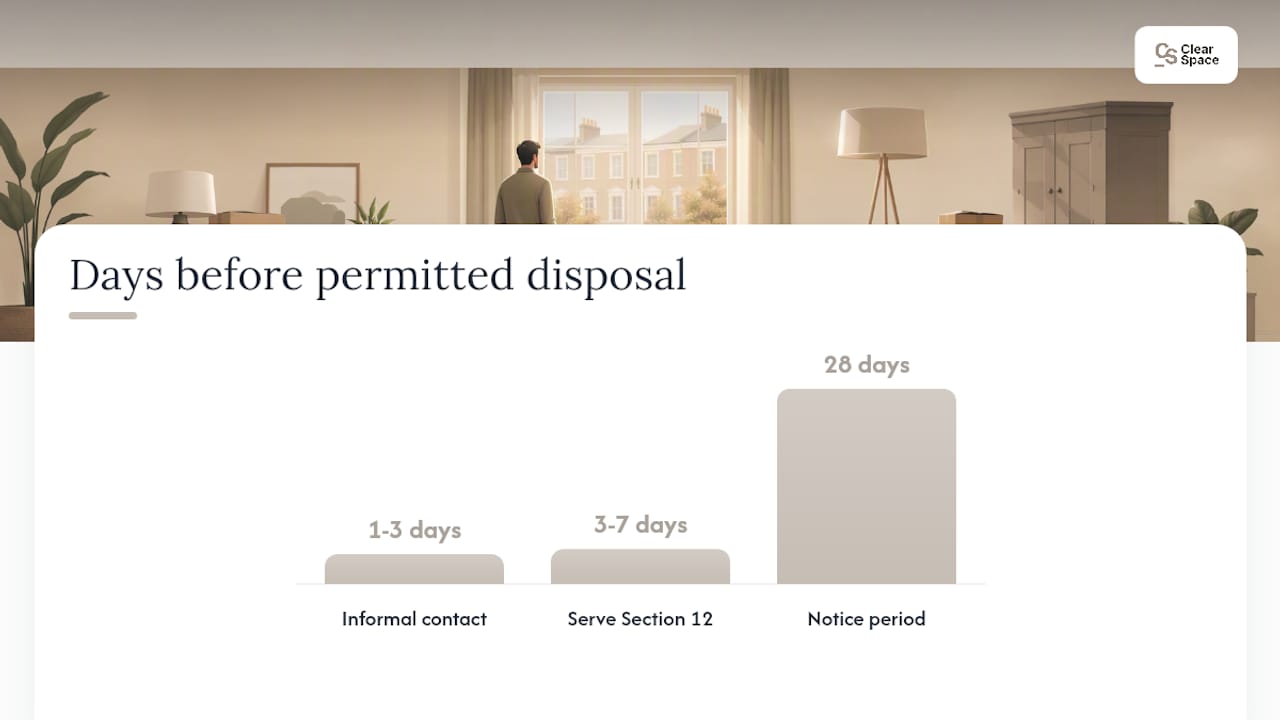
Timeline from notice to permitted next steps:
| Stage | Action | Minimum period |
|---|---|---|
| Day 0 | Goods discovered, inventory and photos taken | Immediate |
| Day 1–3 | Informal contact attempts | As soon as possible |
| Day 3–7 | Section 12 notice served | Before notice period starts |
| Notice period | Tenant has opportunity to collect | Reasonable period (typically 28 days is standard practice, though no statutory minimum is fixed) |
| After notice period | Sell, donate, or dispose if no response | Only after notice period has expired |
| Post-sale | Hold net proceeds for tenant | Reasonable period |
The Simply-Docs guidance note confirms that landlords who follow this procedure and keep records of each stage are in a strong position to defend any later claim.
Storing items, recovering costs and using the deposit
Handling abandoned items procedure costs money, and you are entitled to recover reasonable expenses. The key word is "reasonable," and the key evidence is receipts.
Costs you can typically recover:
- Professional clearance or removal fees.
- Short-term storage charges while the notice period runs.
- Disposal fees for items that cannot be sold or donated.
- End of tenancy cleaning costs where the condition of the property was affected by the left items.
The NRLA confirms that landlords can, in principle, recover these costs from the deposit or seek reimbursement directly, but only where they retain receipts and have acted in compliance with the law.
How to document costs for a deposit deduction or small claim:
| Cost type | Evidence needed | Where to use it |
|---|---|---|
| Clearance / removal | Itemised invoice from contractor | Deposit deduction, small claims |
| Storage | Storage agreement + dated invoices | Deposit deduction, small claims |
| Disposal fees | Receipt from licensed waste carrier | Deposit deduction |
| Cleaning | Itemised invoice with before/after photos | Deposit deduction |
The deposit deduction flow:
- Calculate all reasonable costs with receipts attached.
- Submit a deduction claim to the deposit protection scheme (Tenancy Deposit Scheme, mydeposits, or Deposit Protection Service) within the scheme's deadline.
- If the tenant disputes the deduction, the scheme's adjudicator will review your evidence. Itemised invoices and photographs are what adjudicators look for.
- If costs exceed the deposit, issue a formal written demand to the tenant first. If unpaid, consider the small claims track in the County Court for amounts up to £10,000.
Retain all receipts and invoices for at least six years. That is the standard limitation period for contract claims in England and Wales, and it is the window within which a former tenant could theoretically challenge your deductions.
Special situations: evictions, hazardous items, perishables and animals
Some types of tenant left belongings situations sit outside the standard process and need a different response.
Eviction contexts
When possession has been recovered through a court order and bailiffs have enforced it, the timing of the abandoned items procedure may be compressed. Bailiffs executing a warrant will typically give the tenant a short window to remove belongings. If items remain after enforcement, the same Torts Act procedure applies, but the eviction paperwork provides useful additional evidence of the date possession was taken. Involve your solicitor before the eviction date to plan the post-possession steps.
Hazardous materials
Gas cylinders, chemicals, paint, and similar items cannot simply be left in storage. You should:
- Photograph and log them before touching anything.
- Contact a licensed waste contractor for collection and disposal, retaining the disposal certificate.
- For gas cylinders, contact the relevant supplier directly — most will arrange collection.
- Keep records of every step, including the contractor's name, date, and what was removed.
The Hamlins guidance notes that when disposal is necessary for safety reasons, landlords should still document condition, attempt contact, and use licensed contractors who can provide certificates.
Perishable goods
Food, plants, and other perishables can be disposed of immediately on health and safety grounds. Photograph them first, note them in your inventory, and keep a brief written record of why disposal was necessary.
Animals and pets
A pet left behind is an immediate welfare issue. Contact the RSPCA (0300 1234 999) or your local authority animal welfare team on the same day. Do not attempt to rehome the animal yourself without professional guidance. Keep a record of the date you reported it and to whom.
Personal data on devices and paperwork
Laptops, tablets, hard drives, and paperwork containing personal information require careful handling. Hansells Solicitors advise that items containing personal data should be professionally wiped or shredded, with proof of destruction retained. Disposing of a laptop without wiping it first creates data protection exposure for you, not just the former tenant.
What counts as 'reasonable enquiries' to trace a former tenant
There is no statutory checklist for tracing, but courts and adjudicators look at whether you made a genuine, documented effort. The Porter Dodson guidance confirms that the absence of a fixed statutory timeframe makes your evidence of reasonable enquiries the central issue.
Tracing steps to take and how to evidence each one:
- Phone calls: Log date, time, number dialled, and outcome (no answer, voicemail left, number disconnected). Screenshot the call log.
- Emails: Send to all known addresses. Keep sent copies and any delivery/read receipts.
- Text messages: Screenshot the conversation thread.
- Last known address: If different from the rental property, send a recorded delivery letter. Keep the proof of posting and any returned mail.
- Emergency contact / next of kin: Contact them in writing and keep a copy. Note their response or non-response.
- Guarantor: Write to the guarantor at their last known address. Keep a copy.
- Referencing agent: Ask whether they hold updated contact details for the tenant.
- Social media: A brief, professional message on LinkedIn or Facebook is a legitimate step. Screenshot the message and any response.
- Credit reference tracing services: Low-cost trace providers can locate a current address using the tenant's name and date of birth. Costs are typically modest and the report itself becomes part of your evidence file.
Pro Tip: Compile all tracing attempts into a single dated document before serving the Section 12 notice. If the matter ever reaches a deposit adjudicator or court, presenting a chronological log is far more persuasive than a folder of loose screenshots. Tenant communication standards — including written records of every contact attempt — are increasingly expected by adjudicators.
When tracing fails and the goods are high-value, consult a solicitor about applying to court for authority to sell. The cost of a brief legal consultation is small compared to a conversion claim.
When to consult a solicitor or apply to court
Most abandoned items situations can be handled without legal advice. A few cannot.
Seek a solicitor's input when:
- Any item appears to be worth more than a few hundred pounds and ownership is unclear.
- A third party has contacted you claiming ownership of goods.
- The former tenant has written to dispute your right to sell or dispose.
- The tenancy ended in contested circumstances (eviction, abandonment, rent arrears dispute).
- You cannot trace the tenant at all and the goods are high-value.
- The deposit has been disputed and costs are significant.
Russell-Cooke note that in rare high-value disputes, applying to court for a sale order or preservation order is appropriate. Courts can grant authority to sell goods and directions on how to hold the proceeds, which removes the landlord's personal liability for the decision.
What to bring to a solicitor:
- Your dated photographic inventory.
- A copy of the tenancy agreement.
- All correspondence with the tenant (emails, texts, letters).
- The Section 12 notice and proof of service.
- Any evidence of third-party ownership claims.
- Receipts for storage or clearance costs already incurred.
A well-prepared file cuts the time a solicitor needs to advise you and reduces your costs.
How a professional clearance and storage service reduces your risk
The practical workflow for handling left behind possessions is easier to manage when a single supplier handles multiple steps. Here is how a professional service integrates with the legal process:
Example workflow:
- Secure and document: Landlord or agent photographs and inventories all items on day 0.
- Remove non-saleable rubbish: A licensed clearance contractor removes broken, soiled, or clearly worthless items, providing a dated receipt and waste transfer note.
- Store saleable items off-site: Items of apparent value go into secure, insured storage while the Section 12 notice period runs. The storage provider issues a dated agreement and itemised inventory.
- Provide receipts: Every step generates a receipt that can be used to support a deposit deduction or small claim.
- Prepare the property: Once the notice period has expired and items have been collected, sold, or disposed of lawfully, the property is cleaned and prepared for re-letting.
Supplier checklist for landlords:
- Public liability insurance (ask for the certificate).
- Waste carrier licence for any rubbish removal (check the Environment Agency register).
- Secure, insured storage with individual receipts and inventories.
- Professional data destruction for devices and paperwork, with a destruction certificate.
- Itemised invoices for every service, suitable for deposit deduction evidence.
Using a single local provider for clearance, storage, and end of tenancy cleaning simplifies evidence collection considerably — just like professional Estate & eviction clean‑outs services streamline the process for landlords elsewhere. One supplier, one invoice trail, one point of contact. For landlords managing multiple properties, that consistency matters. See the professional clearance guide for more on what to expect from a reputable service.
The part most landlords get wrong
Most landlords who end up facing a conversion claim did not set out to do anything wrong. They looked at a pile of broken furniture and bin bags and made a reasonable-sounding decision: it is rubbish, it is gone. The problem is that "reasonable-sounding" and "legally defensible" are not the same thing.
The Torts Act procedure feels bureaucratic when you are standing in a property that needs to be re-let. But the documentation step takes an hour, not a day. Serving a Section 12 notice costs nothing beyond a stamp and a printer. The 28-day wait is frustrating, but it is the price of legal certainty.
What I find genuinely underappreciated is how much the quality of your opening inventory affects everything downstream. A thorough day-0 record closes off most disputes before they start. A tenant who later claims their belongings were valuable has a much harder argument when you have timestamped photographs showing the actual condition of every item. Adjudicators and judges notice the difference between a landlord who documented carefully and one who did not.
The other thing worth saying plainly: combining clearance with end of tenancy cleaning is not just convenient, it is strategically sensible. A void property costs money every day. Getting clearance, storage, and cleaning handled by one provider in a single visit cuts the turnaround time and produces a single, coherent evidence trail. That is not a luxury for large portfolios — it is the most practical approach for any landlord who wants to re-let quickly and sleep soundly.
Clearspaceherts helps Hertfordshire landlords get properties re-let faster
When a tenant leaves belongings behind, the clock is running on your void period. Clearspaceherts handles the practical side so you can focus on the legal steps: licensed property clearance, secure off-site storage with itemised receipts, and end of tenancy cleaning in Hertfordshire that produces the documented, photographic evidence deposit schemes expect.
As a local, family-run business covering St Albans, Harpenden, Hemel Hempstead, Welwyn Garden City, Hatfield and surrounding areas, Clearspaceherts combines clearance, storage, and cleaning into one straightforward package. Every job comes with itemised invoices suitable for deposit deductions, a waste transfer note for any rubbish removed, and a single point of contact throughout. For house clearance in Hertfordshire or a combined landlord package, get in touch today to arrange a visit and a no-obligation quote.
Sources
Official and professional resources for landlords handling tenant property left behind:
- Torts (Interference with Goods) Act 1977: Schedule 1
- Torts Act notice Q&A – Guidance for landlords | Porter Dodson LLP
- What to do if a tenant leaves belongings behind – NRLA
- Practical Law: Torts (Interference with Goods) Act 1977 notice (example)
- Don't just bin it — considerations before disposing of tenants' belongings — Russell‑Cooke
- Guidance note: dealing with property left behind by residential tenants — Simply‑Docs
- What to do when your tenant vacates but leaves belongings behind - Hansells
- The Torts (Interference with Goods) Act 1977: guidance for landlords — Hamlins
This article provides general information for landlords in England and Wales. It is not legal advice. For high-value goods, disputed ownership, or contested tenancies, consult a qualified solicitor before taking action.
This article is general information, not a substitute for advice from a qualified lawyer. Consult a qualified legal professional about your own circumstances before acting on anything here.